
The three islands of Paris
Share
Paris is a city full of surprises. In fact, it is home to three islands, all located on the Seine: two natural islands—Île Saint-Louis and Île de la Cité—and one artificial island—Île aux Cygnes.
Île Saint-Louis
Located in the 4thth arrondissement of Paris (Hôtel de Ville neighborhood), it is the most populous island despite having a smaller area than Île de la Cité. Its residents are known as Ludovisiens or Ludoviciens. The island is crossed by its main street, “Rue Saint-Louis-en-l’Île,” which is home to the Church of Saint-Louis-en-l’Île, among other landmarks.
There are also many shops, residences, and mansions that showcase 17th- and 18th-century architecture. Upon arriving on the island, you pass through a park dedicated to the famous artist Antoine-Louis Barye.
There is no direct underground access. However, the nearest metro stations are Pont Marie and Sully-Morland on Line 7.
It is accessible via 5 bridges:
- The Saint-Louis Bridge, which connects it to the Île de la Cité
- The Sully Bridge
- The Marie Bridge
- The Louis-Philippe Bridge
- The Tournelle Bridge
Île de la Cité
Located between 1and and 4th arrondissement of Paris, it is considered the birthplace of the city of Paris, as it comprises the Cité district—the oldest part of the city, formerly known as Lutetia. It is home to some of Paris’s most iconic landmarks: the Sainte-Chapelle, Notre-Dame Cathedral with its famous Gothic architecture, the Palais de Justice—formerly known as the Palais de la Cité, where the kings of France once resided—and more. It also features several green spaces as well as four squares: the Place du Pont-Neuf, the Place Dauphine—one of Paris’s five royal squares—the forecourt of Notre-Dame (Place Jean Paul II), and the Place Louis-Lépine. The island’s architecture bears the mark of the Haussmannian influence of the era but has been modernized with the addition of new monuments.
It is said to be surrounded by two branches of the Seine: the Grand Bras to the north and the Petit Bras to the south.
This island can be reached via the underground from the Cité metro station on Line 4.
It can also be reached via nine bridges, which make this walk more enjoyable.
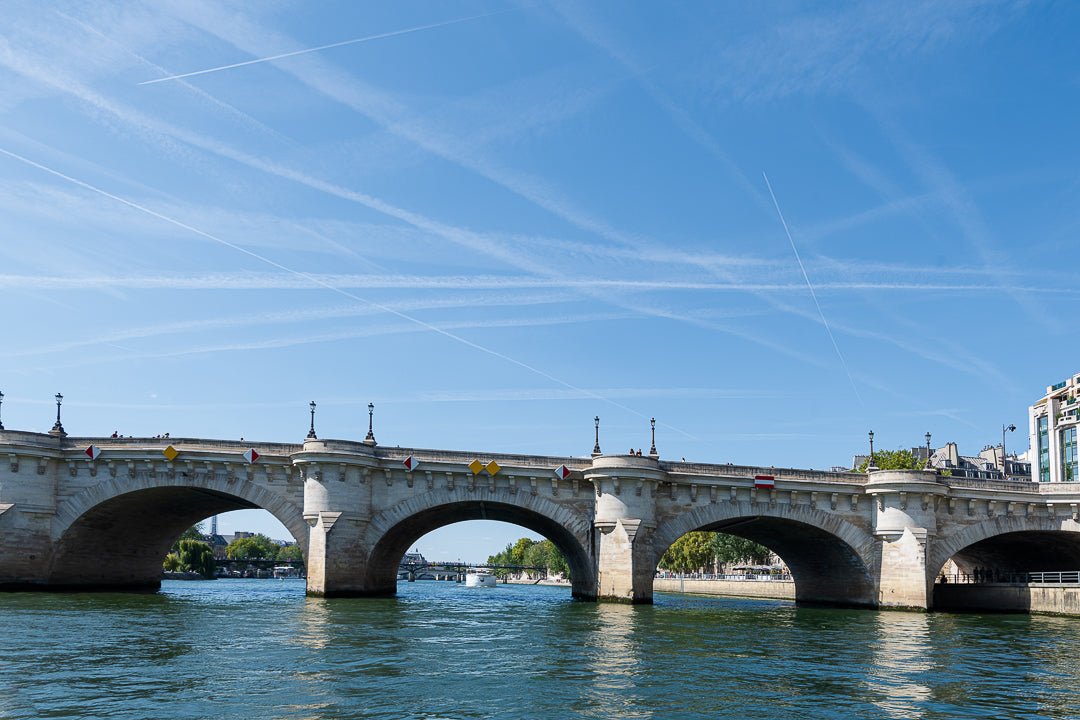
There, you'll find the only bridge spanning the two branches (the Grand Bras and the Petit Bras) and connecting the right and left banks, which is called the Pont Neuf.
The three bridges that span the Grand Bras, connecting the island to the right bank, are
- The Pont au Change
- The Notre-Dame Bridge
- The Arcole Bridge
As well as the four bridges that span the Petit Bras, connecting the island to the left bank, which are
- The Saint-Michel Bridge
- Le Petit-Pont
- The Bridge at Double
- The Archbishop's Bridge
Swan Island
Located between 15and and 16thth arrondissements, it is the only artificial island in Paris. Its name comes from the former Île des Cygnes, which was located in what is now the 7thth arrondissement. It stretches for nearly one kilometer and is located between the Grenelle and Bir Hakeim bridges.
Most of this island is taken up by the Allée des Cygnes, a wide public promenade lined with benches and surrounded by trees. At the end of this promenade, near the Grenelle Bridge, stands a replica of the Statue of Liberty. The island offers a natural setting perfect for strolls, while providing a view of the Eiffel Tower away from the crowds of tourists. In addition, numerous sports facilities have been installed, allowing visitors and residents alike to enjoy the green space while exercising.
Access to this island via the subway is available through the Avenue du Président Kennedy RER station.
It is also accessible via three bridges:
- The Bir-Hakeim Bridge
- The Rouelle Bridge
- The Grenelle Bridge
You can therefore explore these three islands on foot via the bridges or the metro, or admire them from a boat during a cruise on the Seine.